Two asteroids hid in plain sight for 12 years. I found them.
2026-10-08 · Space · Submitted, awaiting the Minor Planet Center
In March 2014 a supernova survey pointed the Blanco 4-meter telescope in Chile at one patch of sky 20 times over five nights. The images went into a public archive. Asteroids drifted through them, and most were reported. Two weren’t.
What I did
The survey was the High cadence Transient Survey (HiTS). It wanted exploding stars, not asteroids, so moving dots were background to it. Its images sit in NOIRLab’s archive, and a catalog built from them lists every dot in every frame.
I pulled every dot that appears once and never again, and linked the ones that move in a straight line through a single night: 1,754 moving objects.
I checked each against every known asteroid’s predicted position at that moment, and against the Minor Planet Center’s own files of reports from this telescope. 1,503 were already known.
Of the rest, 17 showed up on two nights and fit one orbit around the Sun.
I used each orbit to predict where the object should be on the other nights, and went looking. Two were there, again and again.
For those two I went back to the original pixels: tied every frame to the Gaia star catalog (15–37 stars per chip), measured the positions and brightness myself, and checked each detection by eye.
The two
1F916A: a small main-belt asteroid Strongest candidate
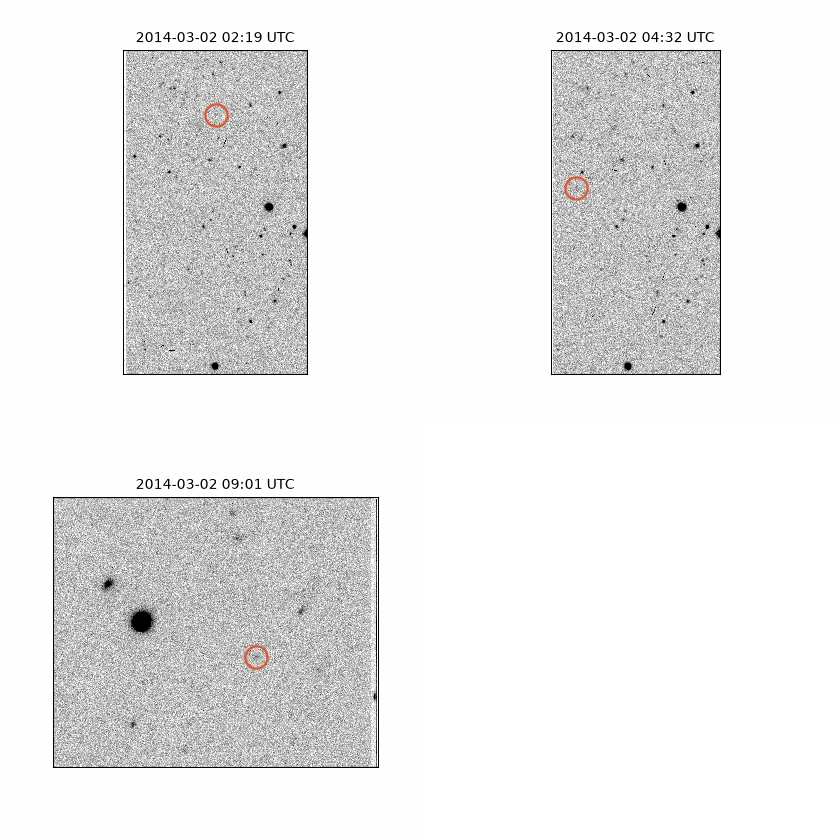
The same patch of sky, three exposures on 2 March 2014. Stars stay put. The circled dot moves.
Detections
13, on all five nights (1–5 March 2014)
Orbit fit
0.11 arcseconds average miss across all 13
Orbit
2.28 AU from the Sun, nearly circular (e 0.06), tilted 6.9°, one lap every 3.4 years
Size
Roughly 300–650 m, from its brightness and a range of likely surface darkness
Brightness
Magnitude 21.5–22.9 (Gaia G)
How sure
It’s a real object
Near-certain
The same dot moves along one orbit for five nights. Those spots are empty on other nights.
Nobody reported it
High
It isn’t in the Minor Planet Center’s files for this telescope and these dates, and no known asteroid passes close enough.
It gets a new designation
Likely
The Minor Planet Center’s own matching settles it.
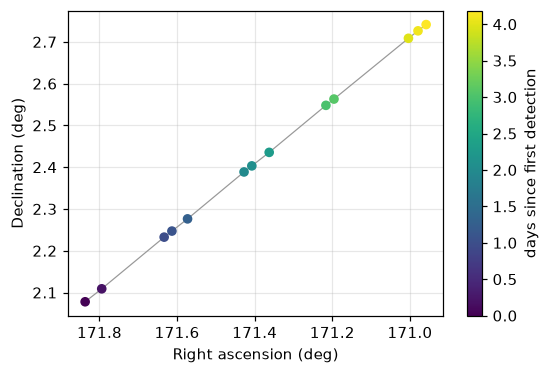
Every detection reported, a 24-arcsecond box centered on the object.Its path across the sky, colored by day.All 13 measurements
UTC (mid-exposure)
RA°
Dec°
G mag
S/N
Gaia stars
2014-03-01 02:29:17
171.837004
+2.077876
22.50
8
31
2014-03-01 07:17:26
171.794238
+2.108932
22.89
7
25
2014-03-02 02:19:51
171.633381
+2.232603
22.01
10
26
2014-03-02 04:32:49
171.613408
+2.247119
21.98
7
15
2014-03-02 09:01:12
171.573109
+2.276301
22.52
7
19
2014-03-03 02:05:08
171.427511
+2.388607
21.51
13
36
2014-03-03 04:17:18
171.407485
+2.403130
21.89
20
34
2014-03-03 09:10:30
171.362719
+2.435479
21.96
13
20
2014-03-04 02:06:51
171.216503
+2.548070
21.94
12
31
2014-03-04 04:21:38
171.195771
+2.563097
21.94
20
29
2014-03-05 02:03:29
171.003927
+2.708487
22.21
7
32
2014-03-05 04:41:48
170.979247
+2.726353
21.83
15
29
2014-03-05 06:56:09
170.958309
+2.741340
21.82
11
23
1F916B: a slow one, out near Jupiter The bigger story
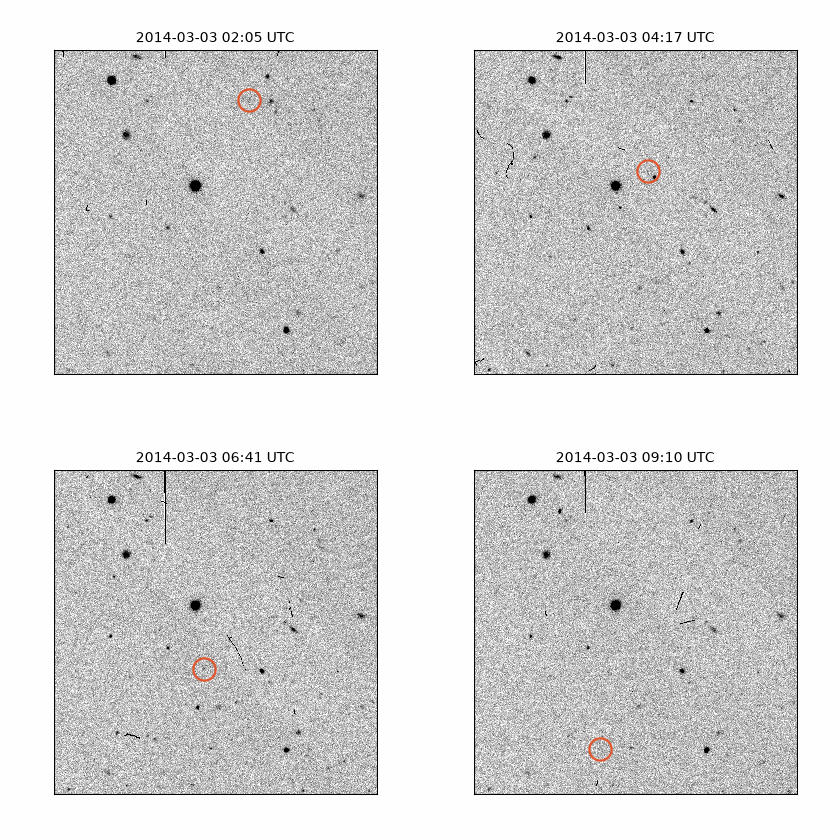
Four exposures on 3 March 2014. This one is fainter and slower.
Detections
10, on four nights (2–5 March 2014)
Orbit fit
0.35 arcseconds average miss
Distance
Its slow drift puts it near Jupiter’s distance from the Sun, roughly 5 AU, in the stretch of sky where Jupiter’s leading Trojan asteroids gather
Size
A few kilometers across, if it’s as dark as objects out there usually are
Brightness
Magnitude 22.2–23.1 (Gaia G): fainter than 1F916A, but much farther away, so much bigger
How sure
It’s a real object
Very high
The same dot sits on one path across four nights. It’s fainter, so each detection is noisier.
Nobody reported it
High
Same checks as 1F916A.
It’s a Jupiter Trojan
Open
Its distance fits, but four nights can’t pin the orbit down. One fit looks like a Trojan’s, another doesn’t. A longer arc will tell.
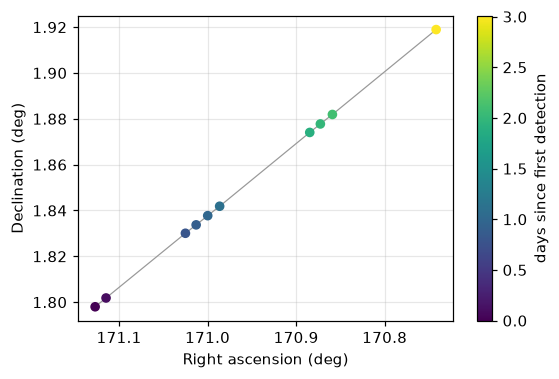
Every detection reported, a 24-arcsecond box centered on the object.Its path across the sky, colored by day.All 10 measurements
UTC (mid-exposure)
RA°
Dec°
G mag
S/N
Gaia stars
2014-03-02 06:43:06
171.127024
+1.797984
22.58
9
34
2014-03-02 09:01:12
171.114703
+1.801827
22.52
7
32
2014-03-03 02:05:08
171.025055
+1.830058
22.88
6
33
2014-03-03 04:17:18
171.012939
+1.833724
23.07
8
33
2014-03-03 06:41:42
170.999860
+1.837740
22.48
11
35
2014-03-03 09:10:30
170.986385
+1.841849
22.93
6
23
2014-03-04 04:21:38
170.884617
+1.874051
22.84
6
37
2014-03-04 06:32:05
170.872638
+1.877748
22.92
7
36
2014-03-04 09:01:51
170.859030
+1.881885
22.30
8
35
2014-03-05 06:56:09
170.741875
+1.918924
22.19
7
19
One more detection of 1F916B, on 1 March, sat beside a bad column at the edge of the camera chip. It almost certainly shows the object, but it stayed out of the record.
Status
Submitted to the Minor Planet Center on 2026-10-08. Submission ID 2026-10-08T16:46:09.769_0000CFay. All 23 observations were accepted for processing and given observation IDs, which the Center only assigns to observations it doesn’t already have.
Next: the Center either gives each object a provisional designation or matches it to something already known, and decides discovery credit. Either way, this page will say so.
Credits and receipts
Images: Blanco 4-m telescope and Dark Energy Camera, Cerro Tololo, Chile. HiTS survey (program 2014A-0608, PI F. Förster), observed by L. Galbany and S. González-Gaitán. Served by NOIRLab’s Astro Data Archive and Astro Data Lab.
Catalog: NOIRLab Source Catalog DR2.
Known-object checks: IMCCE’s SkyBoT, and the Minor Planet Center’s observation files.